- Participate
Meet Heather Scott, 1984 Video Designer
Our Education Officer, Indra Wilson, caught up with 1984 Video Designer Heather Scott to talk about how video and technology help bring the world of 1984 to life on stage.
What does an AV/Video Designer do in a theatre production, and what was your journey into becoming an AV/Video Designer?
First, AV stands for Audio Visual. In most cases, productions will have separate designers for both disciplines. For audio, usually a Sound Designer or Composer. Then for any visual elements involving video, you have a Video Designer. Sometimes known as a Projection Designer or Video Artist, it is very dependent on the individual. Video Design is still quite new to most productions, so the discipline is still finding its way and terms. But in essence, it is a Designer who designs and creates visual content which can come in a variety of methods and modes. Common uses on set would be LED screens, projection, or live cameras. It’s a discipline that is constantly evolving and growing, so having hard definitions is difficult to encapsulate. Due to it being quite a new discipline, it also doesn’t have the traditional pathway into it that other design careers have. There are very few Video Design courses, and I don’t think I know any Designers who have done that path. Many studied Set or LX design and had an interest in Video, so shifted focus. For myself, my background is in animation. I have had no theatre training, so that has been my big learning curve. All of my knowledge was for video in a different context for film or TV. In 2022, I applied for a Video Design Internship at National Theatre Scotland. Where I got to shadow the whole theatre production process. I got to learn from Video Designer Andrezj Goulding, and from that connection I was offered to assist on his next show. Then, skipping forward 4 years, I have been an associate to Andrezj on 3 different productions and worked on both small- and large-scale projects across the UK and abroad. Now, in the last year, I have begun to design my own productions.
What was your role in creating the video and AV design for 1984? When did you become involved in the process?
So, as the (Video) Designer, I am responsible for the projection that is used in the show. I work with the director and other designers to create the look and feel of the production. I first got involved with the production when Dominic Hill, the director, asked if I was interested in getting involved. 1984 is a great production for design that lends itself to video with themes of surveillance, etc but also such incredible themes to explore design within it. We had an initial meeting to discuss what he wanted to do for the show. Dominic and I have a shared understanding that there should always be a reason for video to be on stage. It can’t simply be used as a replacement for set design to show location changes. So we explored what parts of the story could benefit from video elements. Then, from early discussions, I began to sketch out and test ideas, finding a visual language. But the real impact of Video is discovered once you are in technical rehearsals; we can prep as much content as we need. But until you are in the room with the set and atmosphere, that is when you can truly design what will work in the context.
Selection of big projections
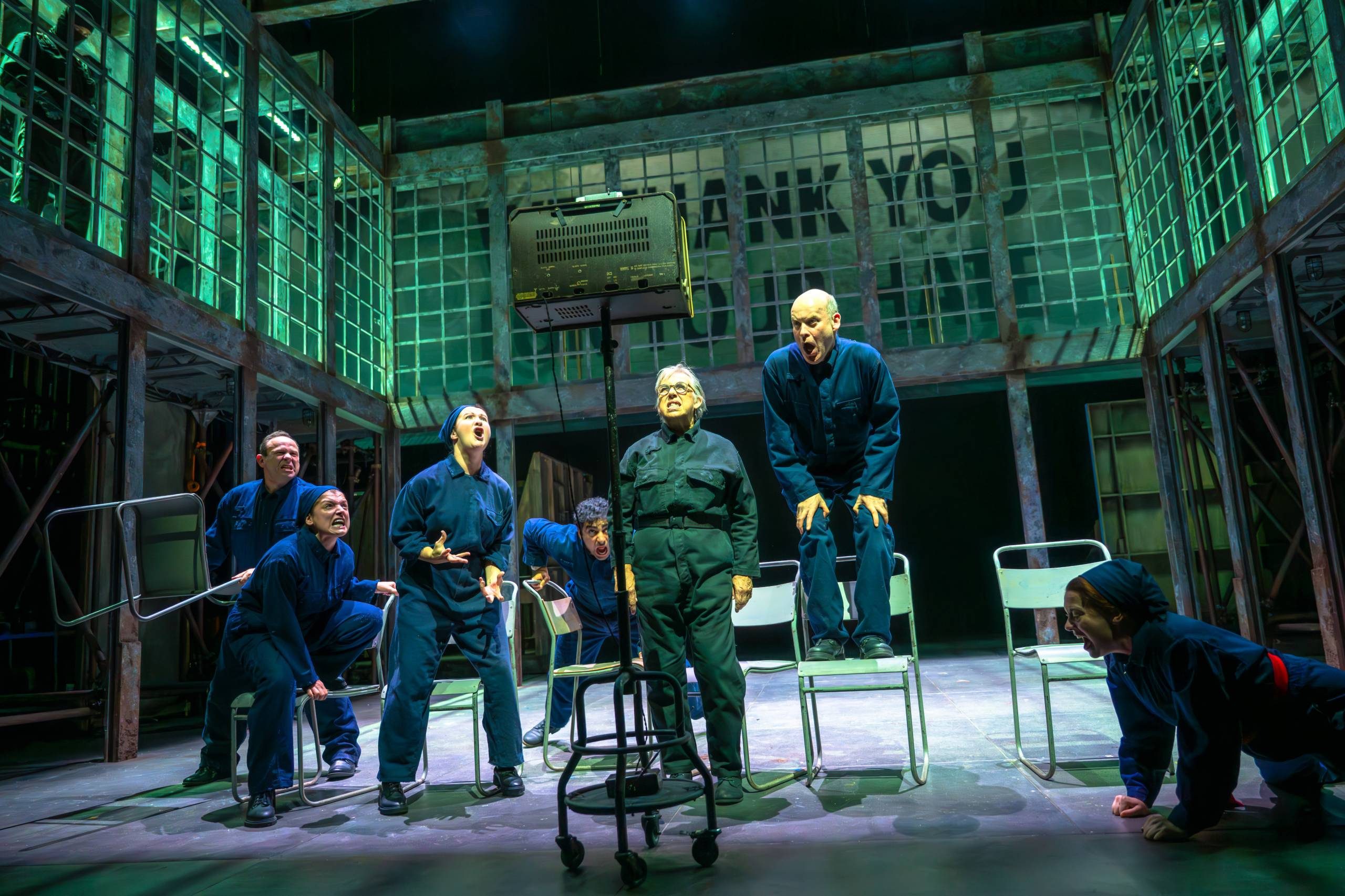
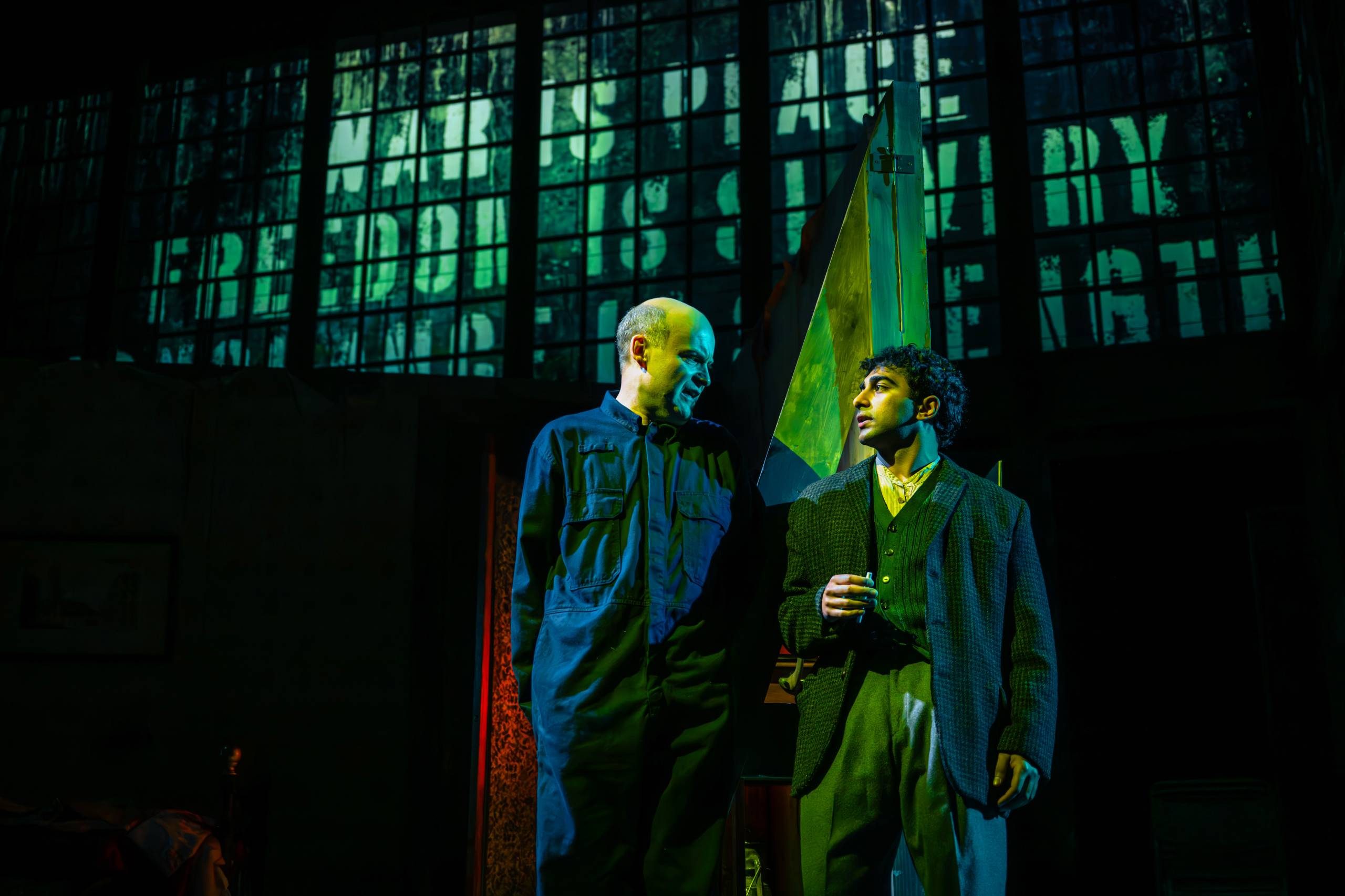
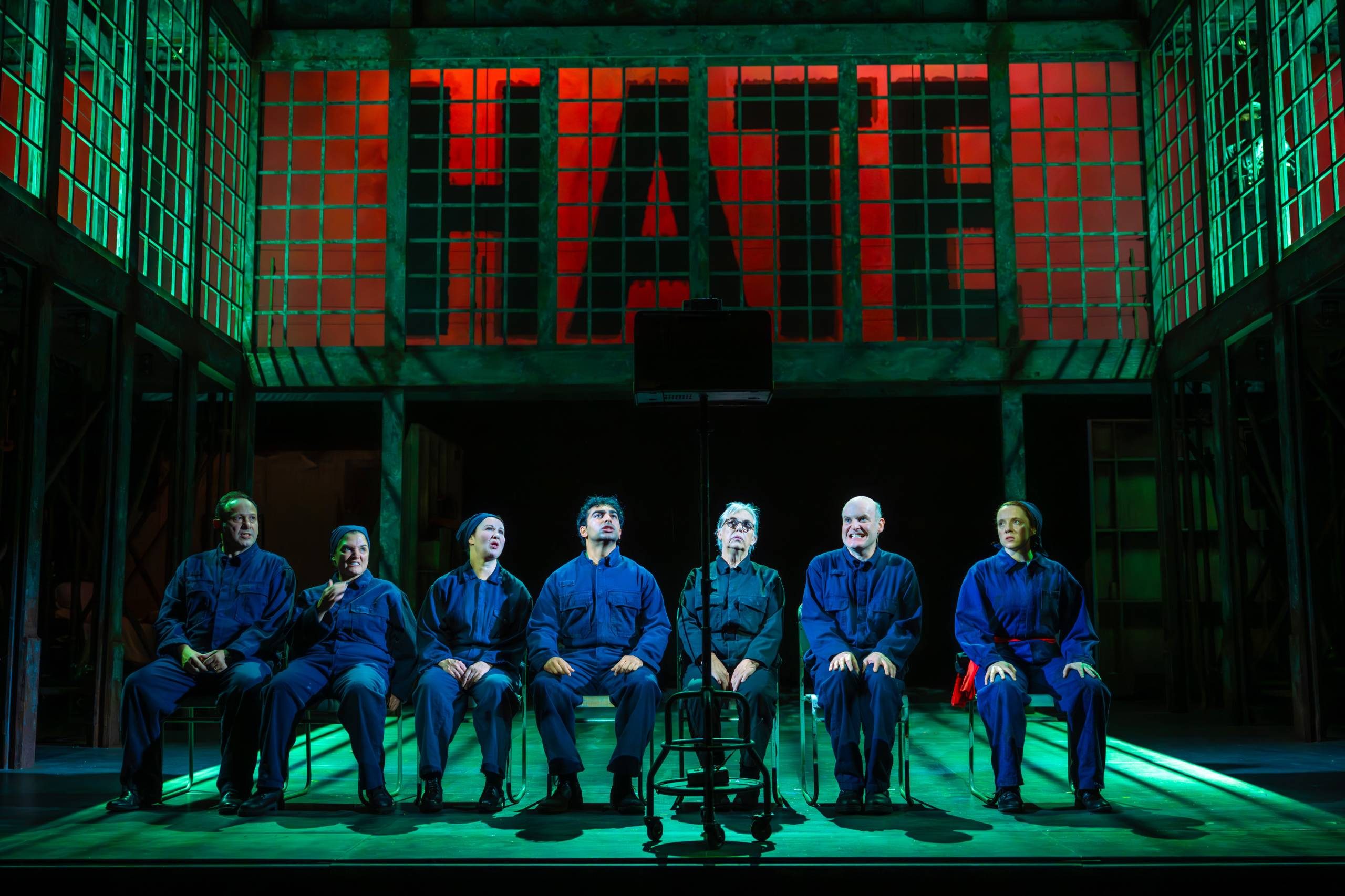
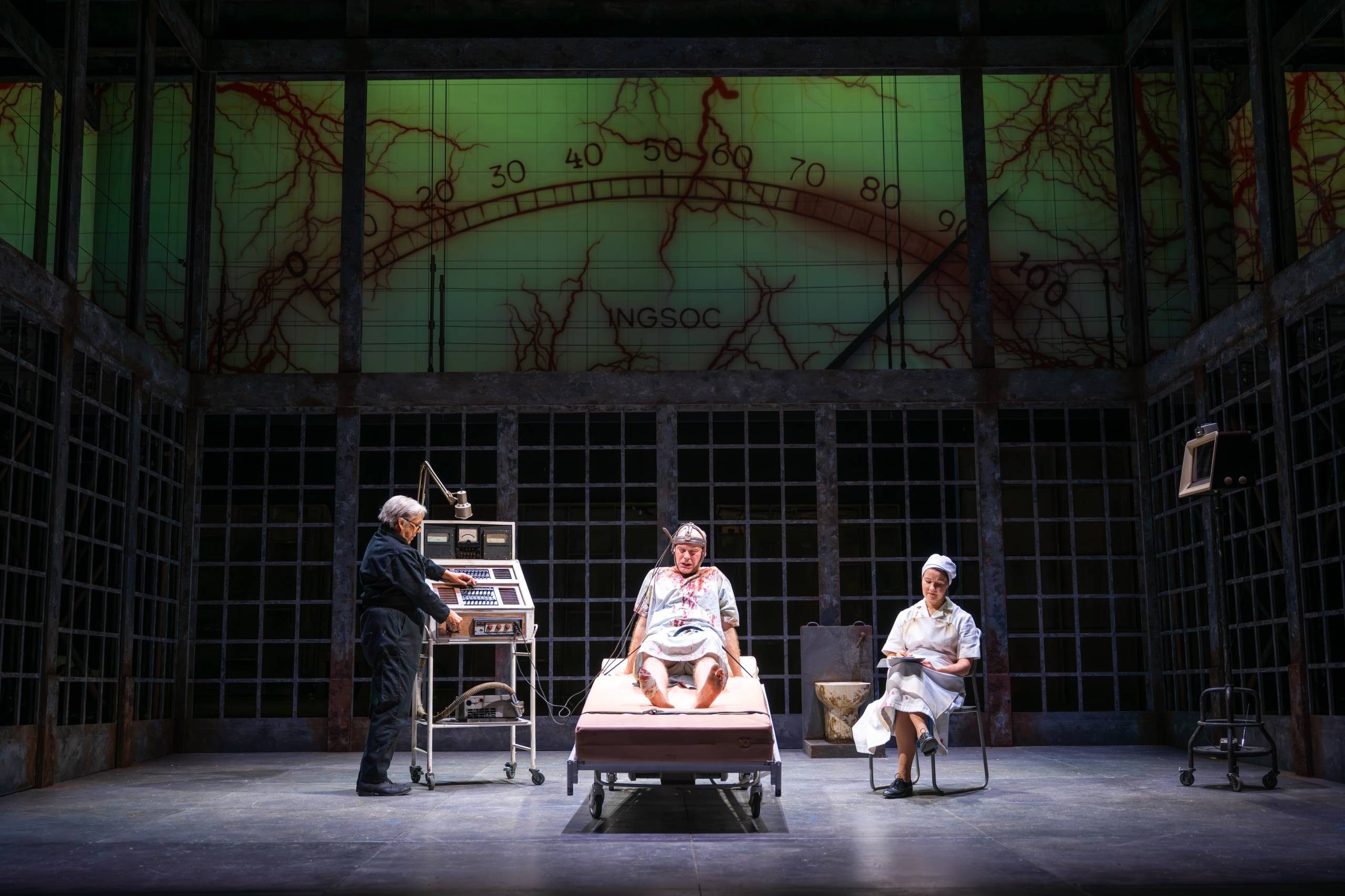
How did you use video to help create the world of 1984 and Oceania?
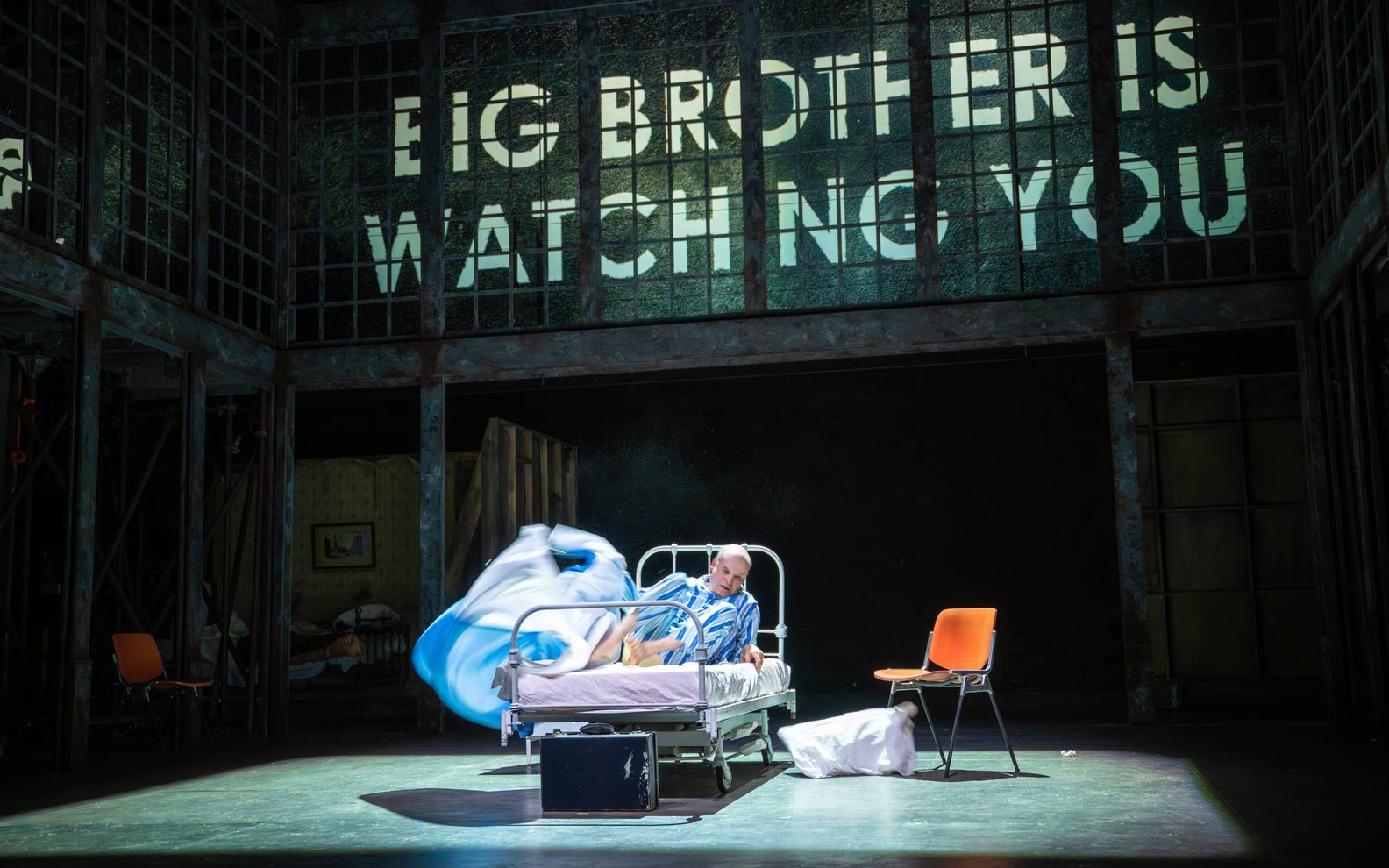
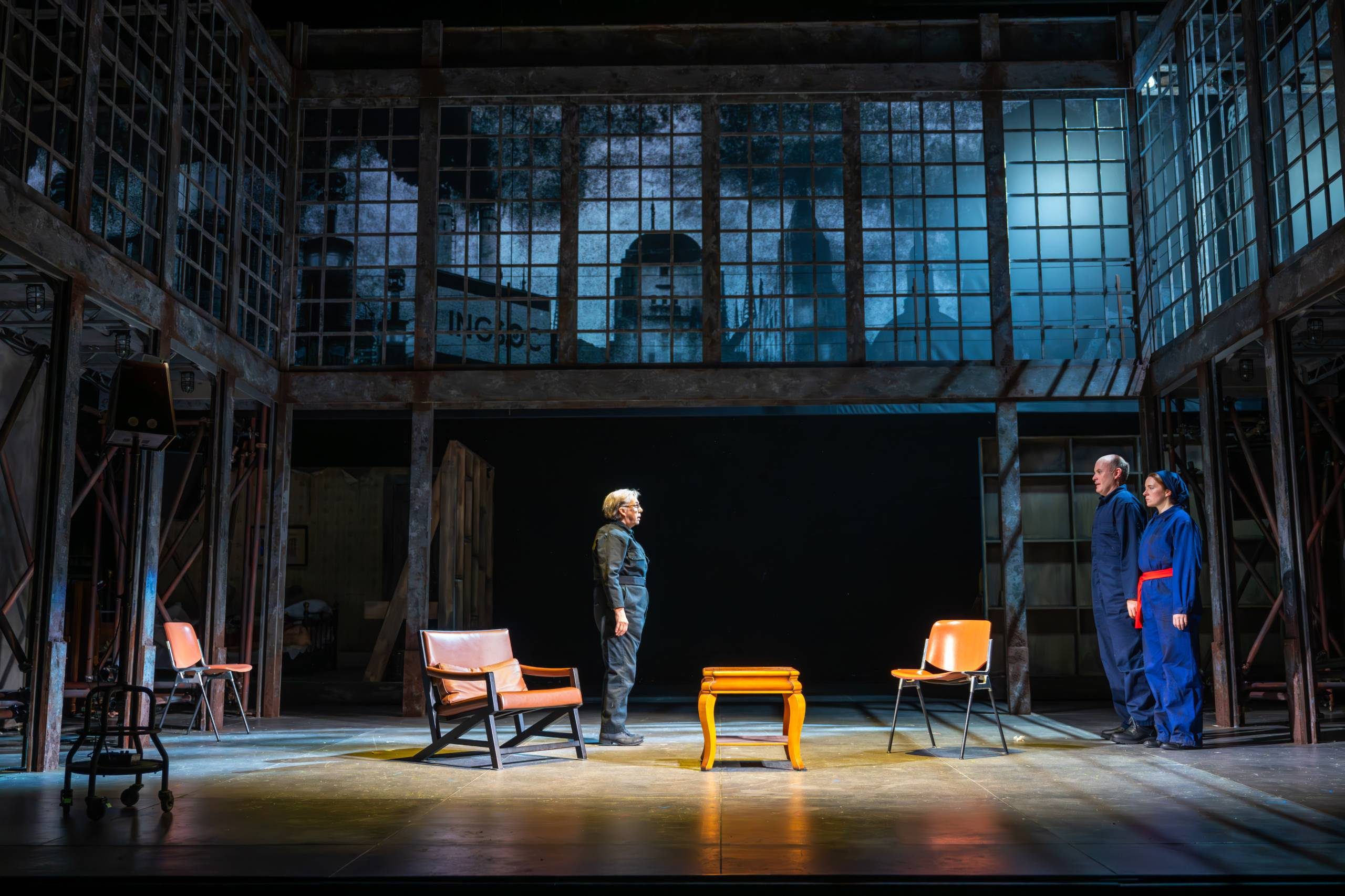
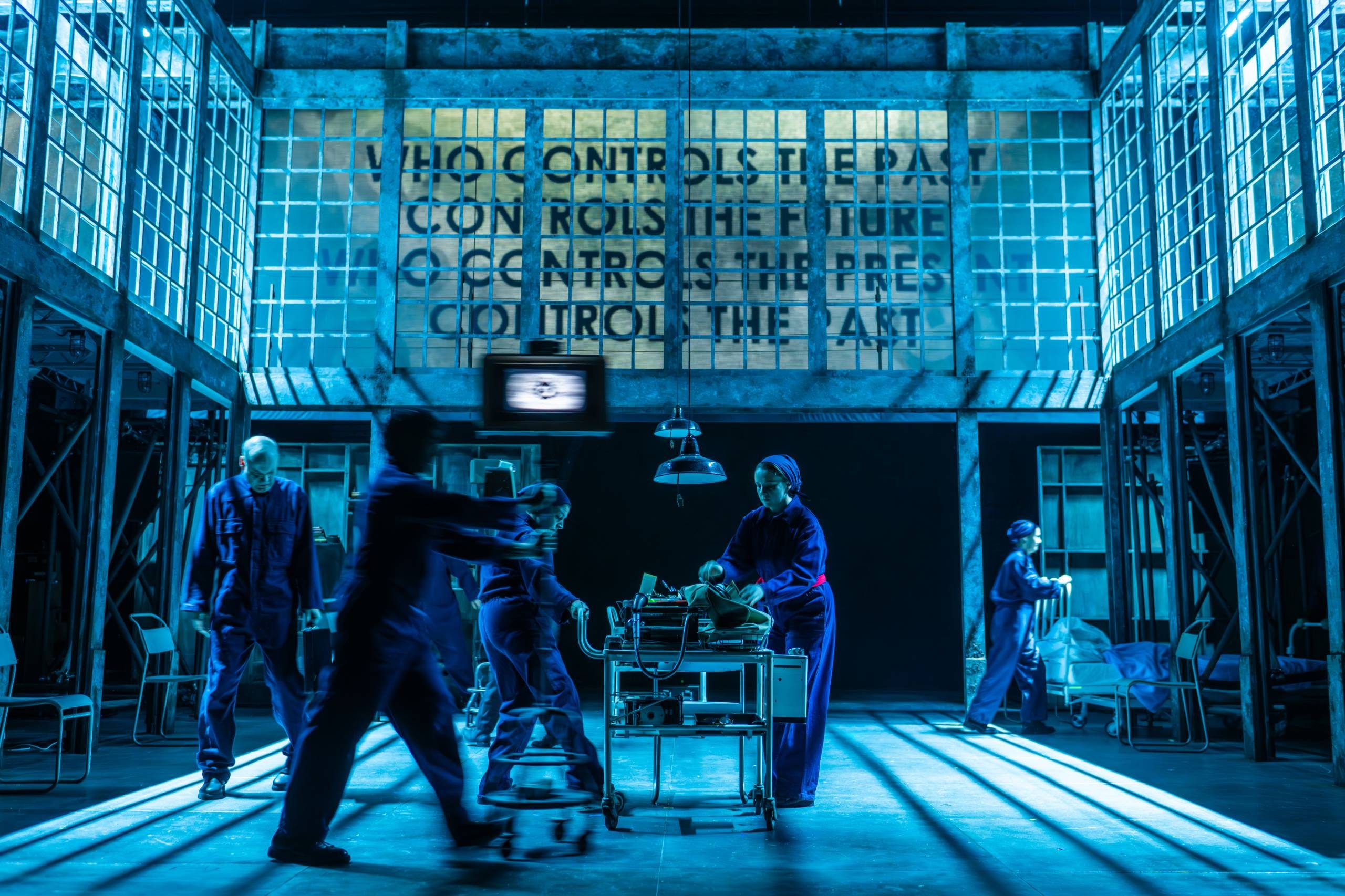
Our projections help express the language and presence of The Party throughout the show. Tom Piper, the set and costume designer, and I talked a lot about what the world looks and feels like. What design references to use for architecture and typography. The design includes a lot of text, showing the propaganda our characters are surrounded by. Simplicity can be a very effective tool, and making sure each choice is purposeful. It all helps to create an effective design which works with the entire set. A key part of our story is to highlight that Orwell wrote the story in Glasgow while in hospital. So the design includes references to the real world outside of the story, and throughout the piece I wanted the world to look textured and include inky washes connecting it to the typewriter and ink of the writing.
The world of 1984 is dominated by surveillance. How did this idea influence your video design?
Obviously, cameras are a huge part of the novel, and in modern theatre the use of live camera is becoming more common. It was something we discussed a lot. In the end, we have made the bold choice to not include any cameras or recorded footage. Dominic and I agreed from the beginning that we didn’t want to do the expected. We have physical telescreens as props with monitors built in that act as these cameras; these help communicate the constant surveillance. But there is no actual camera used in the show.
How did you work with the director and other designers to make sure the video fit with the overall production?
It’s all about communication and sharing ideas to have a collective vision. One of my favourite parts of my job is that everyone in the room has their speciality and we can all be amazed at what each other does. It’s when we come all together that each element lifts and accentuates each other. Video Design sits in between the visual worlds of set and lighting. So one of the most important parts of the process is finding the harmony between the departments. The best video design can sometimes be the one you barely notice and that it camouflages with the set and creates a seamless environment on stage. Then with sound and lighting, we create the show together, looking for moments we can collaborate on so that everything the audience experiences feels like a full sensory experience.
How can video change the way an audience understands a character, scene or moment?
In 1984 specifically, video helped to show the presence of the Party and Big Brother. This throughout the play is an ominous threat of a character that we don’t really see. Our projections help fill out the locations of the world. We can visually see the slogans and propaganda that make up the environment, and we see the News broadcasts and working conditions, which help explain the media our characters are experiencing. So we help to build out the character by showing its presence through elements of the world. Another example in this show would be Winston’s monologues where he addresses the audience directly. These are separate from the real world of the play in Oceania and the real world of Orwell. So the video changes into this inky nebula to express that we are going into the subconscious of Winston. We can see glimpses of things he is talking about, but also the fluid ink connects us to the reality of Orwell’s writings and thoughts. Video helps communicate the change in storytelling but keeps us in the world of the design. Showing what a character is thinking internally but visually.


Were there any particular challenges in designing the AV for 1984? How did you solve them?
Design-wise, there have been no great challenges; it is a very rich piece of text which is a beautiful gift for a designer to explore and play with. But naturally, with every production, the challenges usually lie with physical technical ability. We can be as creative and imaginative as we want, but there is always the reality of how to make these ideas exist on the stage. Touring a show comes with challenges in itself; different venues have different quirks, from varying dimensions to in-house equipment. We have had to be resourceful with which equipment we can tour and use. Also, how to adapt the design to work in different venues. Our aim is always to ensure as much consistency in each venue we are in so audiences can receive the same impact of performance we are aiming for.
Is there a particular moment in the production where you think the video design is especially important? What does it achieve?
In the show, we have a scene for the 2 Minute Hate where the characters are supposed to be watching this horrific broadcast and actively expressing hatred for what they are watching. The scene is supposed to be intense and uncomfortable. It also becomes the perfect moment for video,o as we use front projection on top of the actors to simulate what they are actually watching. So we have 2 sections: on the rear Projection we have the Party broadcast, which begins in its totalitarian monotone and then, with the soundscape, it develops into this red burning, degraded depiction of true Hate. At the same time, the front projection simulating an old-style film broadcast flashes through grotesque scenes, all obscured. But in many parts of this design, I use this trick; I personally call it the Jaws effect: not showing the scary thing is scarier than seeing it straight in front of you. Our minds do the intense work of imagining the most terrifying thing; the not knowing has more of a personal impact for each individual.
What do you think video can do in theatre that it can’t necessarily do in film or television ?
I think this is still a topic that is being greatly discussed and discovered. A lot of high-end shows are becoming a hybrid of both worlds, which is very exciting to see how that affects new writing and storytelling techniques. Interaction is a huge advantage of live theatre. Characters can react to video content, and vice versa: video content can react to the show with live cameras or audience participation data. Video opens up so many possibilities with its technology that productions can be bolder and more innovative with their storytelling. Having it be live is the aspect that film and TV can’t replicate. The immediacy and tension that live entertainment has is the key to it. Having audiences be a part of the experience in such an intimate way.
What advice would you give to a young person who is interested in becoming an AV or video designer for theatre?
Give it a go. I am constantly learning what this job is, and it has been nearly 5 full years. Video Design is still such a new department in the theatre world. It is still being explored and is an exciting field to be in. It takes alot of patience to find your way. But I would always say the best way is to learn from those and the world around you. There is no ‘correct’ way to do it. Your unique skills and knowledge will come in handy in future scenarios you would not foresee. Getting the opportunity is one of the hardest entry points, but if you can start designing and making in whatever capacity and with whatever equipment you can get. That is an amazing start already. Good luck

Back to 1984 education page
The 1984 education pack is here to help you dig a little deeper into 1984 and the choices behind the production. Head back to the main page to explore more.