1984 Education: George Orwell
Who is George Orwell anyway? And why are we still banging on about him in 2026?
You’ve probably heard of George Orwell, even if you haven’t read his work. You might recognise quotes from 1984 or have heard of the book Animal Farm, or maybe the term “Big Brother” (from a well-known TV show). Perhaps you’ve come across the word “Thoughtcrime” or even the description of something being “Orwellian”.But who actually was he, and why are we still studying his work almost 75 years after his death?
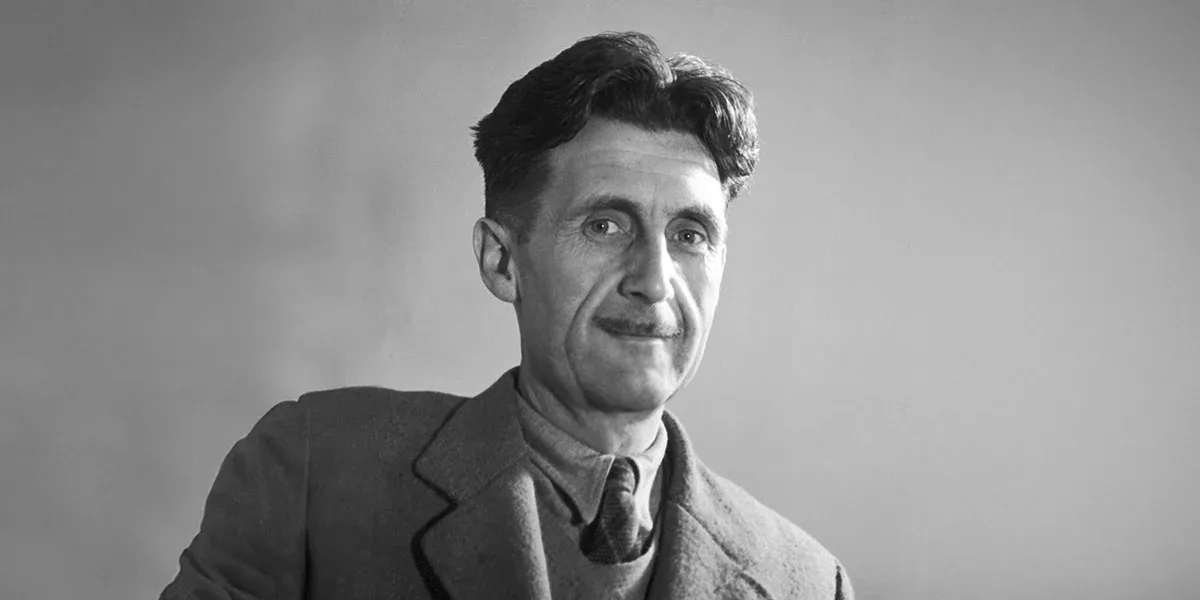
George Orwell was an English writer, journalist and political commentator born in 1903 in India under British colonial occupation.
FUN FACT: George Orwell was actually his pen name; his birth name was Eric Arthur Blair.
He came from a middle-class family and was educated at Eton College. Although it was expected of him to attend university, he chose instead to join the Indian Imperial Police in Burma (which we now recognise as Myanmar) where he worked from 1922 to 1927.
Orwell and politics
His experiences there had a significant impact on his political thinking and writing, as being part of the British colonial system exposed him to the realities of imperialism and inequality. Eventually, he resigned from the police and returned to Britain, he is said to have felt more comfortable living among poorer communities in London and Paris. He took on various jobs, including waiter, cleaner, and dishwasher, while supporting his writing career. He even experienced poverty firsthand, which profoundly influenced his work. Orwell became particularly interested in the lives of people who were often overlooked by those in power. His early book, “Down and Out in Paris and London” (1933), delves into class struggles in the UK.
Orwell was deeply interested in politics, but his views developed through experience rather than theory alone. He became a democratic socialist and strongly opposed any political systems that used violence, propaganda and authoritarian control. His political commitment led him to Spain in 1936 to join the military resistance against the Fascist government. His political life strongly influenced his writing, including his portrayal of totalitarianism in 1984.
From his life to 1984
His personal life also shaped his writing. Orwell married Eileen O’Shaughnessy in 1936, and they adopted their son, Richard, in 1944. Eileen was an Oxford graduate and poet. Eileen supported Orwell’s writing and worked with him during some of the most difficult periods of his life. She died suddenly in 1945, leaving Orwell to raise their young son while continuing his work as a writer. Many years later, he met Sonia Brownell. Sonia Brownell was an editor who worked for the popular literary magazine Horizon. She was part of London’s highest literary and artistic circles and worked closely with writers and artists. Orwell married Sonia on 13 October 1949, while he was being treated for tuberculosis.
Orwell died in 1950, just one year after 1984 was published. He therefore never saw how impactful the novel would become or how many of its ideas would become a part of our everyday language. However, his experiences help us understand where the novel’s concerns came from. His experiences with imperialism, poverty, political conflict, love and propaganda shaped the questions he explored in his writing. 1984 takes these concerns and pushes them to an extreme.
Other Influences on Orwell’s writing
All writers are influenced by the people and relationships around them. It feels important to acknowledge Eileen O’Shaughnessy (Orwell’s first wife) and the ways in which her contributions may have been overlooked through the years. Although Eileen’s work and ideas have historically received far less recognition than Orwell’s, some scholars have begun to explore the influence she may have had on his writing. For example, Eileen wrote a poem titled “End of the Century, 1984”, which explores ideas of surveillance and authoritarianism and has prompted discussion about the origins and development of themes later associated with 1984. The novel was published four years after Eileen’s death. This does not diminish the importance of 1984 or the reasons why its themes of surveillance, weaponised hatred, language and control continue to be relevant today. Instead, it allows us to think critically about whose voices are remembered, whose contributions are recognised, and who gets to be considered one of history’s “greats.”

Back to 1984 education page
The 1984 education pack is here to help you dig a little deeper into 1984 and the choices behind the production. Head back to the main page to explore more.